
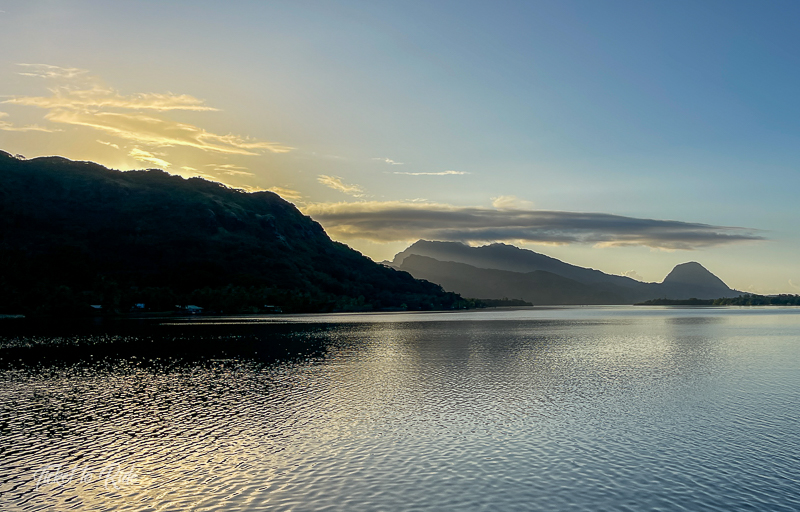
We recently said goodbye French Polynesia which had been a major item on our sailing “bucket list.” We had an amazing time exploring French Polynesia, but after two years, we were ready to up anchor and head off to explore a new country.

Although I had not heard of Niue until a few months ago, my limited research had me excited about reaching this tiny island in the middle of nowhere in the South Pacific Ocean. Our voyage would be approximately 1160 nautical miles and Frank and I were setting out to make this trip on what we hoped would be a mild and mostly downwind passage.
The whole country of Niue is approximately 100 square miles and there is only one place to stop – the mooring field on the west side of the island. Niue does not allow anchoring, so the mooring field is the only option and if the wind turns to the west, boats are required to leave because it is unsafe to be on the lee shore of this coral island.
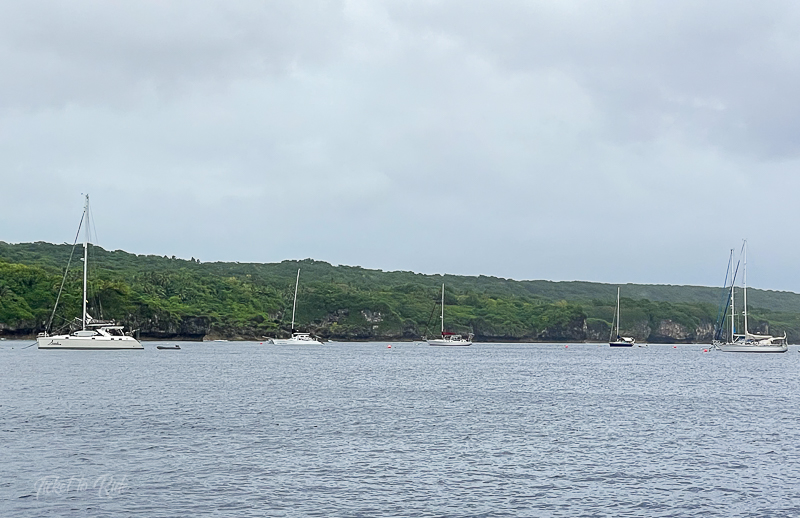
For those reasons, the tricky thing about sailing to Niue is that you must time your passage for reasonable sailing weather and arrive when the wind is not expected to turn westerly, so you can stay for a few days. Plus, you must secure a mooring ball reservation and there are only about 18 moorings available in Niue.
We knew the World ARC, a group of sailing boats who travel together around the world, would arrive in Niue not long after our anticipated arrival and we wanted to be certain we could get settled before they arrived.
Luckily, we worked with Keith, the Niue Yacht Club Commadore, and he reserved the “last” mooring ball for us.
Once our departure date for Niue was set, I looked at what friends had written about their experiences in Niue and I was eager to arrive. What none of them mentioned in their blogs, was what a challenge the passage from FP to Niue had been for them. In hindsight, I am glad I was unaware of their sentiments.
Saturday, May 11th we awakened to light rain and no wind. The weather forecast we chose for our passage was expected to be slow for the first 24 hours but we didn’t expect the rain that greeted us at sunrise. We were a little slow departing in the dreary weather and didn’t actually take off until 7am. Sadly our start was even slower than anticipated and we ended up motor sailing for the first 30 hours of our trip. But at least the sun came out, the skies were blue and the seas were calm.
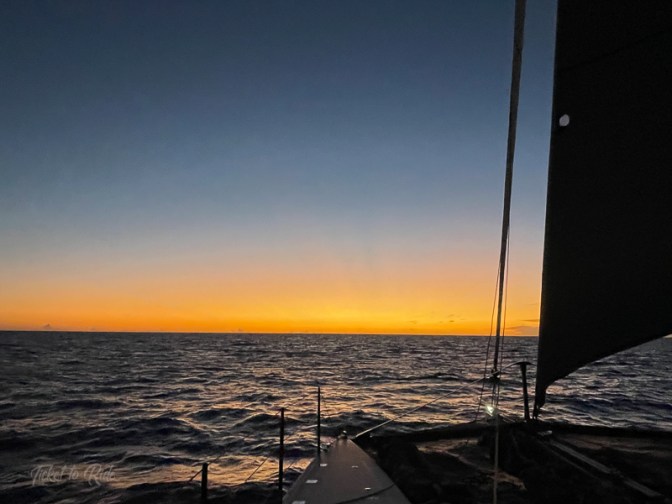
Although the beginning of the passage was expected to have light wind, once the wind filled in, it was expected to stay above 20 knots, so we began our trip with one reef in the main.
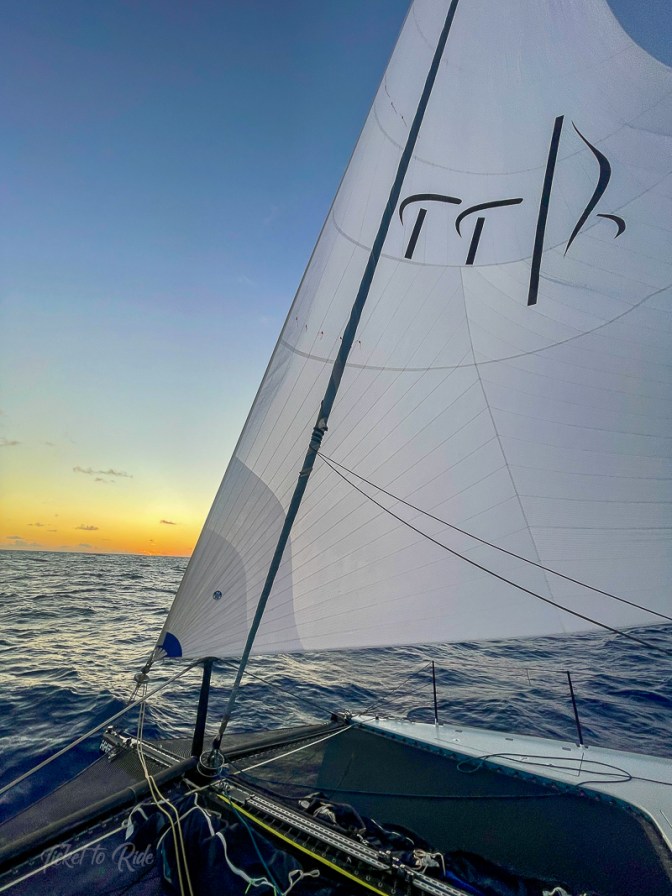
Around 11am on Sunday, the wind finally filled in enough for us to sail. We deployed our downwind sail, the “Drifter,” and turned off the engine. The Drifter is a 195 meter, 3 ounce, lightweight Dacron sail on a continuous line, topdown furler which we use at true wind angles of 110 to 155 on the center line. The entire torque rope is encased in the luff and we use this sail instead of an assymetric spinnaker. TTR is definitely faster under sail than under motor and it was great to use the breeze to propel us more quickly.
The forecast mentioned that we might encounter waves in the four to five meter range and I was definitely interested in getting miles under our keel before encountering any 15 foot waves. In fact, I was hoping we wouldn’t see them at all.
On watches, Frank and I take long shifts to ensure we get decent sleep. It makes the watches long sometimes, but for us, it makes certain we get some quality sleep when off watch.
By 10 pm Sunday, the wind was consistently above 20 knots and I awakened Frank to furl the Drifter. Although the boat was comfortable, the apparent wind speeds were becoming too much for the lightweight sail.
Even after a slow start to the day, we had covered 197nm by 10 pm and we would make more than 200nm on Sunday. I decided it was better to be cautious and make sure we didn’t tear the downwind sail at the start of our passage rather than push the boundaries of the sails limits.
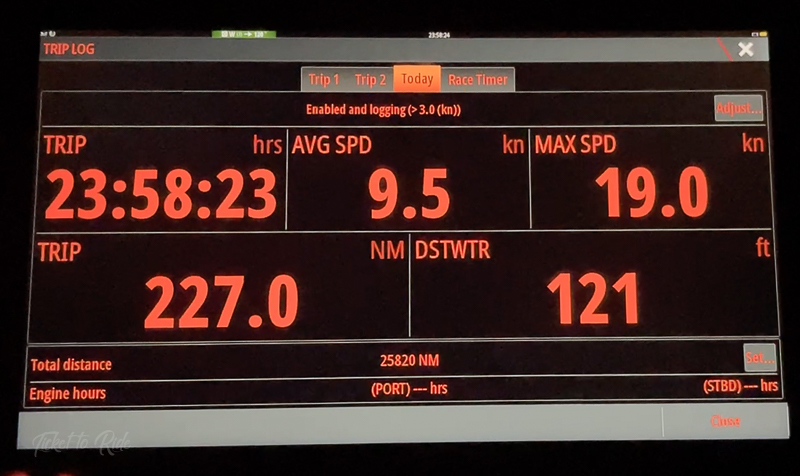
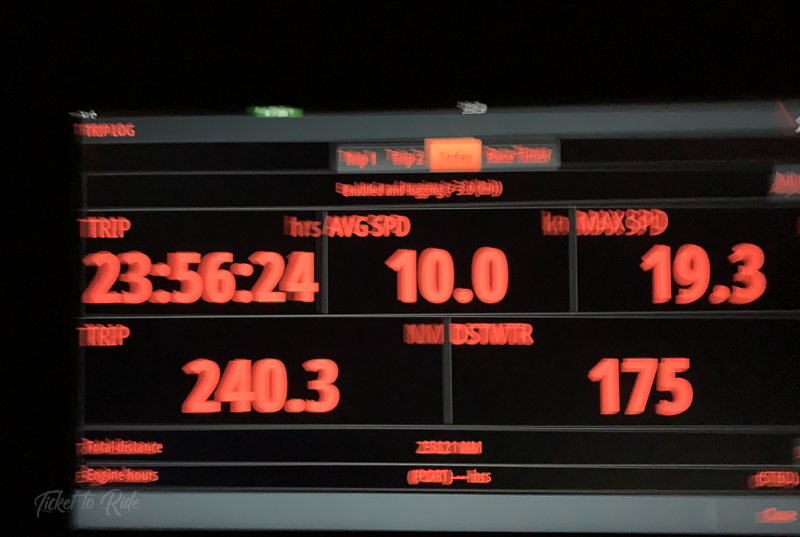
Monday was a good day with our average boat speed at 9.6 knots. During the day we flew the main R1 and the Drifter, but around 10:30 pm once again we had to furl the Drifter and deploy the genoa. The apparent wind speeds were becoming too much for the Drifter. The seas were building, but still manageable.
Tuesday the seas continued to build but I don’t think they were more than 3.5 meters. The wind was slightly higher and we flew the main and genoa all day. TTR is certainly capable of handling greater speeds than we were making, but when it is just Frank and me on board, we prefer to sail conservatively. We averaged 10 knots for the day and tucked away plenty of miles.
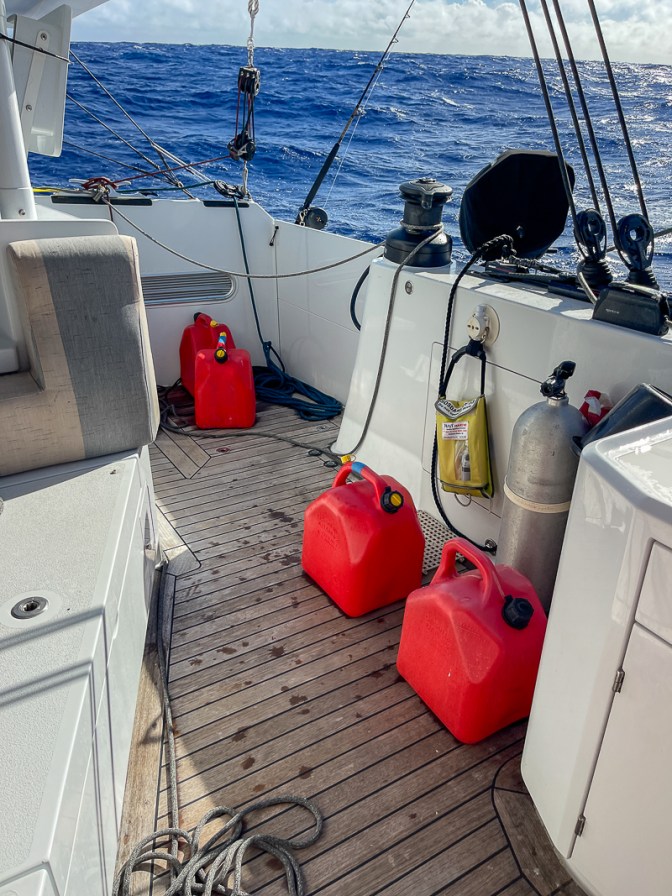
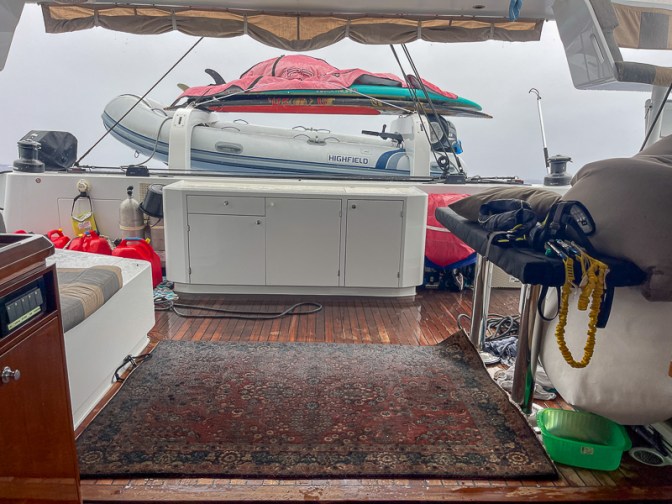
The waves were a little mixed but mostly on the rear quarter and sometimes slammed into the leeward hull causing TTR to shudder. In fact at one point the jerry cans “hopped” across the deck even though they were filled with fuel and heavy.
After three days at sea, we hadn’t seen any other boats, but suddenly on Tuesday afternoon, a boat popped up on our AIS. Shockingly, as always seems to happen in this vast ocean, we see no one and then a ship suddenly appears. In this instance, our information system told us that if we didn’t adjust course, we would pass within NINE FEET of the other vessel!
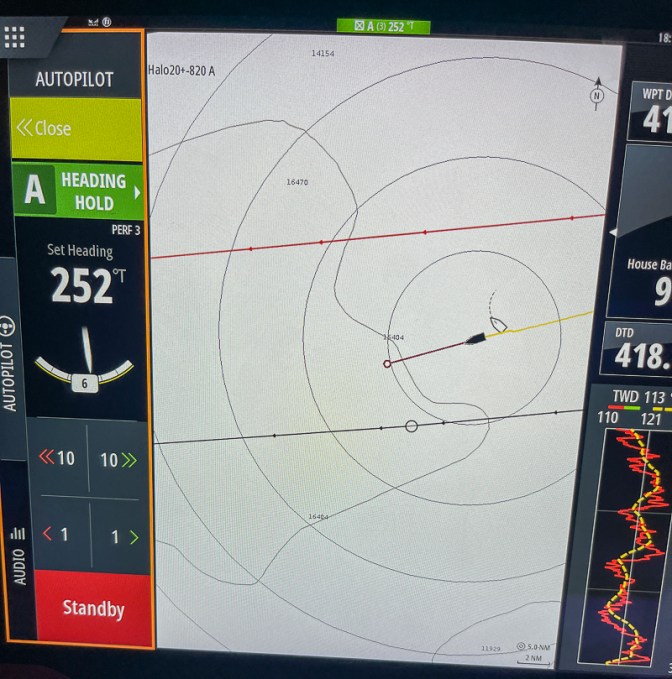
Thankfully the cargo ship had its VHF radio on and answered when we hailed them. Since we were under sail, we technically had the right of way over the much larger cargo ship. I am happy to report that when we requested the vessel change course to go behind Ticket to Ride, they willingly adjusted and passed to our stern. We were happy we didn’t have to adjust our course and sails to avoid the ship.
By Wednesday, Frank and I were tired of the noise and slosh of the seas. The waves had built and we were seeing some of those predicted 4-5 meter waves. Though we don’t often get slapping issues on Ticket To Ride, we were experiencing them in these seas. In fact, the refrigerator drawers would sometimes fly open and on one big slam, the lower drawer flew completely out of the fridge and landed on the floor.
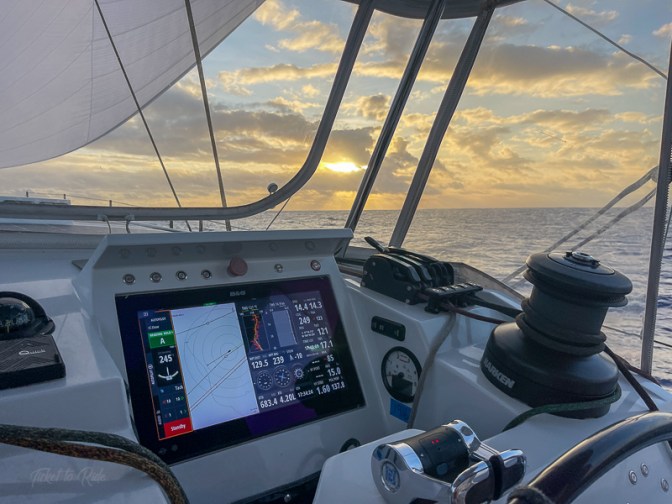
We ended up lightening the drawers by putting heavy items in the cockpit refrigerator and Frank made some adjustments to the drawer locks, which cured the issue. The seas were definitely making themselves known!
The sea state was such that both Tuesday and Wednesday were what we call “sit down sailing days.” There was enough motion on the boat that we didn’t do much other than sit, take watch, sail and sleep.
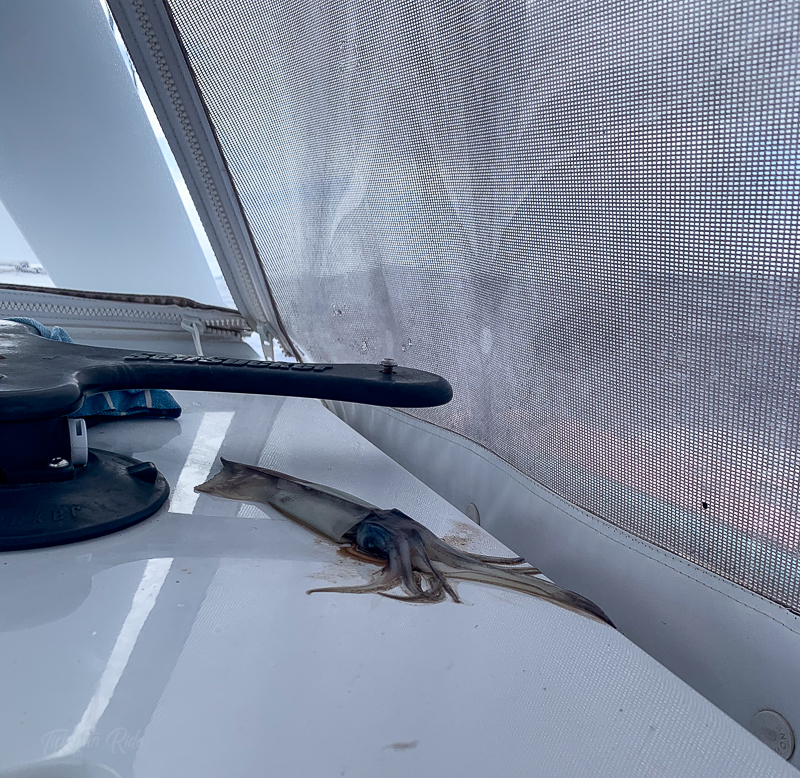
On one of those days, Frank and I were sitting at the helm and we smelled something rather unpleasant. After surreptitiously checking each other, we realized a visitor had been propelled into the helm station on a wave!
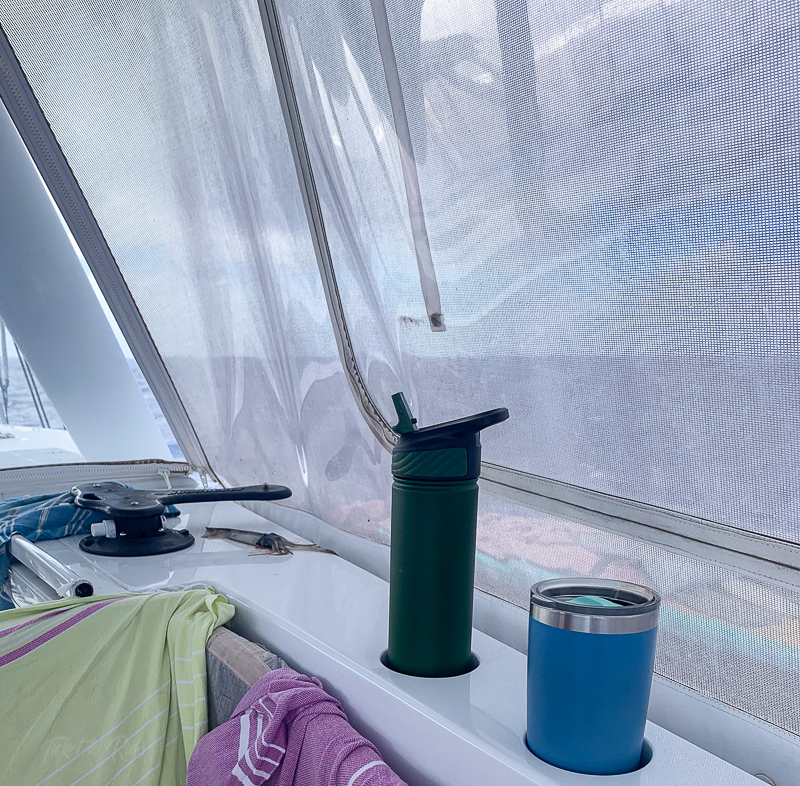
In addition to the waves and deep downwind angles, on Wednesday it began to rain. Since the wind was coming from the rear, the rain was also coming into the cockpit and everything was getting wet. This was one of those passages where even though we don’t have any leaks on TTR, the water and salt get everywhere!
I often say that downwind sailing is “champagne sailing.” But downwind angles have their limitations. When sailing deep downwind as we were, we have to balance the sails properly. When the main sail is up, there is the chance of an accidental gybe, especially if the wind is strong or shifty. We had both strong winds and shifting winds during this passage, especially the last 36 hours.
Early on Thursday, Frank and I were assessing the conditions: big waves, winds sustained in the 20+ knot range, shifting true wind direction and 170 degrees was the optimal wind angle to head to Niue. We discussed several options: sailing wing on wing with the main and genoa; gybing back and forth across the rhumb line all the way to Niue; dropping the main and sailing with just the Drifter but the winds were too high for the Drifter without the protection of the main; dropping the main and sailing downwind under just the genoa.
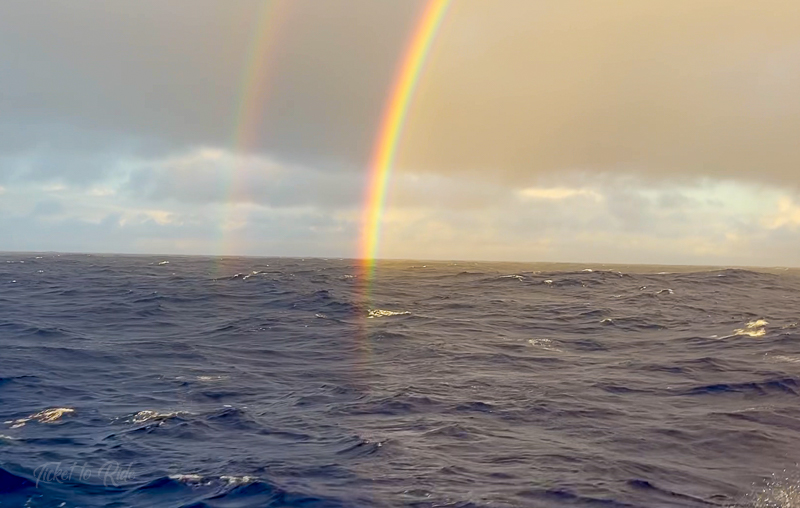
After trying a few of these options, we agreed we were wet and tired and we wanted to arrive in Niue today during the daylight. We decided to drop the main, deploy the genoa, turn on one engine and point directly toward Niue.
So we turned up into the wind to drop the main. However, apparently the “tweaker line” blew overboard during the night and was trailing in the water on the starboard side. The line got wrapped in the starboard propeller and I had to quickly shut down that engine.
Using one engine, we dropped the main, deployed the genoa and used the port engine to complete the last 20 miles to Niue. This plan would insure that we arrived in plenty of daylight to catch a mooring ball and assess the starboard engine.
Thankfully the mooring balls in Niue are spread out and we didn’t have any issue picking up a mooring ball using one engine.
Of course, Frank immediately donned a scuba tank and removed the line from the propeller. Thankfully all is well and the starboard engine is once again in working order.
That is actually the first line wrap we have had on TTR which perhaps is an indication that we were both a bit tired!
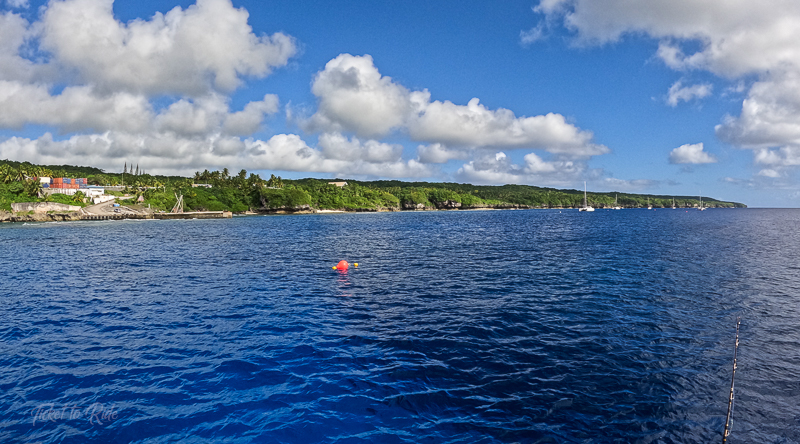
Since arriving in Niue, several friends who were here last year or earlier have reached out to tell us they were happy to hear we had arrived in Niue. Every one of them have told me that this was one of their hardest passages with the biggest seas! Yet not one of them mentioned that in their blogs!!!
Actually, I am happy I didn’t know this was a tough passage. I would have been apprehensive and that might have made the passage more difficult. We were never in any danger while on passage, but there were times when it was rather uncomfortable. Ticket to Ride is an incredibly stable boat and she could be pushed much harder than we push her when sailing with only two on board. Having complete confidence in our boat makes all passages easier.
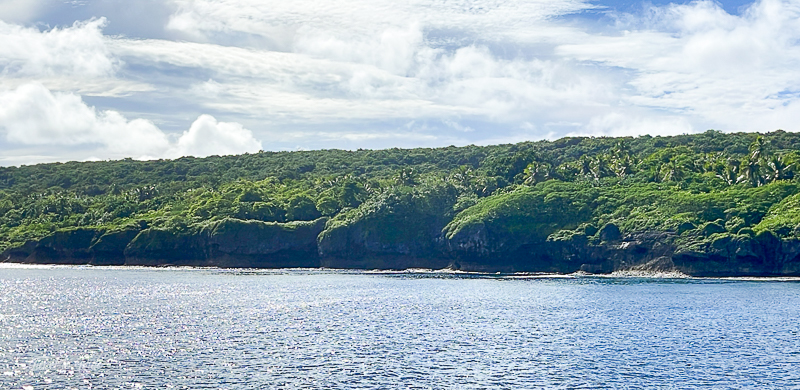
I am beyond thankful for scopolamine patches which have eliminated my issue with seasickness and made it possible for me to function on passages. Without this medication, I would have been miserable!
So, after what I would call a boisterous passage, is Niue worth the effort? The answer is a resounding YES!
This island is beautiful! There are so many interesting places to explore, yet it is small enough to be manageable. The people are friendly and extremely welcoming!
If I am honest, it is also very nice to be in an English speaking country again. I enjoyed trying to improve my French while in French Polynesia, but the ease of communication and the ability to connect so easily with the locals is refreshing and welcome. I am really happy we sailed to Niue!
Thanks so much for stopping by to read our blog. If you would like to hear from us more often, please visit us on Facebook or Instagram. We hope your days are filled with good health and fun adventures.

 Ticket to Ride
What an adventure! Love reading your blog!!
LikeLiked by 1 person
Thank you!
LikeLike
Great post MG. Gripping reading and beautiful photos.
LikeLiked by 2 people
Aww, thanks, Pat.
LikeLike
So glad that you are safely on a mooring ball! The tough sails are among the most memorable sails! Your adventure is amazing!
Warship 44 came within 50 yards of hitting us one evening… the US Navy does not respond on the VHF or change course! Lesson learned!!
LikeLiked by 1 person
Oh Bev, I can’t imagine having a warship that close! Very scary, especially since they do not respond. Turn on warp speed and get out of the way!!
LikeLike
Thanks for the detailed account. Great job! I got seasick just watching your short video — glad you arrived safely (and hooray for your patches that kept seasickness at bay :)) Dawn in California
LikeLiked by 1 person
Oh, Dawn, I think watching the films might be harder than living them, even though the waves don’t show as large as in real life. Glad the video was short and you didn’t need seasickness meds. 🙂 Thanks for reading!
LikeLiked by 1 person
My husband and I read aloud to one another at night. We’ve been around the world with Joshua Slocum, around the continent with Richard Henry Dana, and followed the Wanderer voyages of the Yankee with the Johnson family. You are living the legend! Easier said, than done. Bravo!
LikeLiked by 1 person
That is a very fun tradition you have with your husband!
LikeLiked by 1 person
:))) And you with yours! Sailing :)))
LikeLike